
Transparency Note: This article was written and edited by me — a real human being — with light assistance from AI-based editorial tools for grammar and structural clarity. All examples, data, and contextual insights were authored and verified by me. AI tools were not used to generate financial, technical, or compliance assertions. This disclosure is included for compliance with Medium transparency standards.
Every week brings another framework, another pattern catalogue, another Medium post listing 17 agentic design patterns your team "must know." ReAct. Reflection. Multi-agent orchestration. Plan-and-execute. Delegation chains. Self-modifying agents. The list grows faster than anyone can implement it.
Nobody producing these catalogues is asking the obvious question: which of these patterns actually work when a regulator audits your system?
If you are deploying AI in financial services, healthcare, or any regulated industry, the answer is sobering. Most of these patterns collapse under the weight of compliance requirements. They cannot produce audit trails. They are non-deterministic in ways regulators will not accept. They create cascading failure risks that no risk officer would sign off on.
I examined the dominant agentic AI design patterns against the compliance frameworks that actually govern regulated deployments: the EU AI Act (high-risk requirements effective August 2026), NIST AI RMF, the US Treasury's Financial Services AI Risk Management Framework (February 2026), FCA guidance, and HIPAA. Five patterns survive. The rest are technical debt waiting to become regulatory exposure.
What Regulators Actually Require

Image produced by Gemini-2.5-Flash
Before evaluating patterns, it helps to understand what regulated AI systems must demonstrate. The requirements converge across jurisdictions into five areas.
Explainability and Traceability. Every AI decision must be reproducible and traceable. The EU AI Act mandates that high-risk AI systems enable "effective human oversight" and maintain automatic logging of events relevant to identifying risks. SR 11-7 in US banking requires a clear decision lineage with a full audit trail.
Human Oversight. The EU AI Act requires that high-risk AI systems be designed to allow "appropriately competent" humans to intervene, override, or halt the system. Not optional. A legal obligation from August 2026.
Deterministic Accountability. When something goes wrong, regulators need to identify who or what made the decision, what data informed it, and why the governance layer did or did not intervene. Non-deterministic execution paths are fundamentally incompatible with this requirement.
Lifecycle Risk Management. NIST AI RMF and the Treasury's FS AI RMF (with its 230 control objectives) require documented risk management from design through deployment, monitoring, and retirement. Patterns that cannot be instrumented for continuous monitoring fail this test.
Data Governance and Record-Keeping. High-risk AI systems must maintain detailed technical documentation and enable automatic recording of events. Every input, output, decision, and escalation must be logged in tamper-evident storage.
The 17 Patterns: A Quick Inventory
The agentic AI space includes at least 17 commonly referenced patterns, drawn from Andrew Ng's foundational work, Google Cloud's architecture centre, Microsoft's Agent Factory framework, and catalogues from MachineLearningMastery and SitePoint:
- ReAct (Reasoning + Acting)
- Reflection (Self-critique loops)
- Tool Use (External tool invocation)
- Planning / Plan-and-Execute (Task decomposition)
- Multi-Agent Orchestration (Specialist agent teams)
- Human-in-the-Loop (Human approval gates)
- Delegation Chains (Agent-to-agent task passing)
- RAG (Retrieval-Augmented Generation)
- Self-Modifying Agents (Agents that update their own behaviour)
- Autonomous Goal Pursuit (Open-ended objective completion)
- Memory Persistence (Cross-session context retention)
- Code Generation and Execution (Agents writing and running code)
- Multimodal Agents (Processing multiple data types)
- Evaluator-Optimizer (Separate evaluation and optimisation agents)
- Debate / Adversarial (Agents arguing positions)
- Hierarchical Task Networks (Structured task decomposition trees)
- Swarm Intelligence (Emergent behaviour from many simple agents)
Each has legitimate technical merit. Legitimacy in a research lab, though, is not the same as legitimacy in a regulated deployment.
Why 12 Patterns Fail
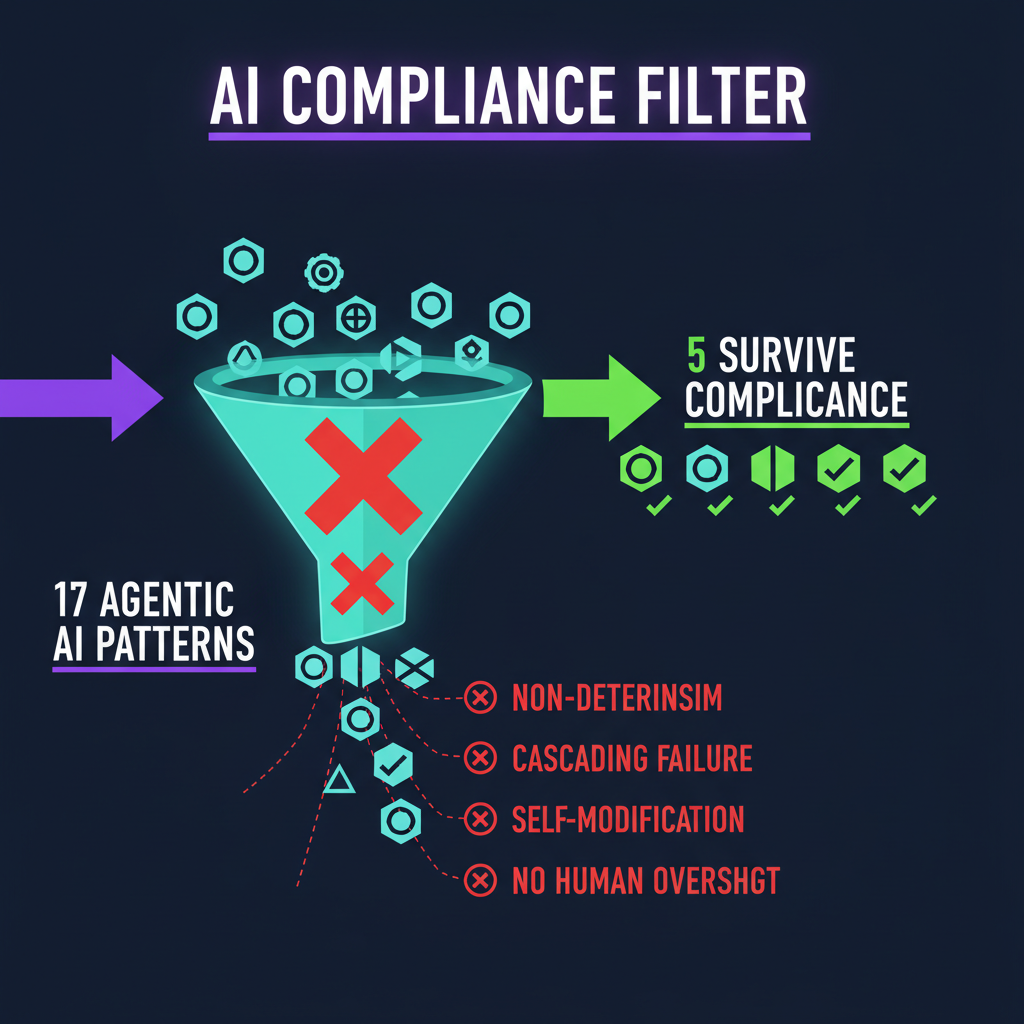
Image produced by Gemini-2.5-Flash
Non-Determinism Kills Auditability
ReAct without logging, autonomous goal pursuit, and swarm intelligence share a fundamental problem: the same input can produce radically different execution paths. Agentic behaviour is non-deterministic by nature. When a regulator asks "Why did your system do X?", you need a deterministic answer. If your agent's behaviour depends on which reasoning chain it happened to explore, you cannot provide one.
Cascading Failures Create Uncontrollable Risk
Delegation chains, multi-agent orchestration in its unrestricted form, and hierarchical task networks create cascading failure risks that are difficult to contain. Production systems encounter cascading hallucinations where one agent hallucinates a policy that downstream agents act upon. Real incidents include agent version deployments that changed output formats slightly, causing dependent agents to fail for up to 47 minutes before rollback. In financial services, 47 minutes of uncontrolled agent behaviour is catastrophic.
Self-Modification Destroys Compliance Baselines
Self-modifying agents and unconstrained memory persistence undermine the very concept of a validated, documented system. The EU AI Act requires detailed technical documentation and conformity assessment. If your agent can modify its own behaviour between assessments, your compliance documentation is immediately outdated. NIST's AI Agent Standards Initiative specifically flags cross-session memory persistence and tool-chain poisoning as attack vectors with no equivalent in the original threat model.
No Meaningful Human Oversight
Autonomous goal pursuit, swarm intelligence, and debate/adversarial patterns typically operate without human checkpoints. The EU AI Act mandates that high-risk AI systems enable effective human oversight as a design requirement, not an afterthought. Patterns that prioritise autonomy over oversight are non-starters.
The Economics Do Not Help Either
Even setting compliance aside, multi-agent orchestration economics often do not add up. Deloitte's research finds that for 70% of use cases, a well-prompted single agent delivers equivalent results at one-third the cost. Gartner warns that over 40% of agentic AI projects will be cancelled by end of 2027 due to escalating costs and inadequate risk controls. IDC predicts that by 2026, 60% of AI failures will stem from governance gaps, not model performance.
The 5 Patterns That Survive Compliance
Pattern 1: Human-in-the-Loop with Confidence-Based Escalation
AI agents process routine decisions autonomously. High-risk, low-confidence, or novel decisions route to human reviewers with full context.
This pattern directly satisfies the EU AI Act's human oversight requirements (Article 14). It creates a natural audit trail: every decision is either auto-approved with logged justification, or human-approved with reviewer identity and timestamp.
In practice, the governance layer assigns a confidence score based on data completeness and policy clarity. Above 95%: autonomous execution with full logging. Between 80% and 95%: flagged for asynchronous human review. Below 80%: synchronous human approval required before execution.
Consider a KYC agent processing customer due diligence. Standard cases with complete documentation pass through automatically. Cases with missing documents, politically exposed persons, or unusual patterns escalate to compliance analysts. The agent's preliminary assessment, supporting evidence, and the specific policy clause that triggered escalation all travel with the case.
Regulatory alignment: EU AI Act Article 14, NIST AI RMF GOVERN function, Treasury FS AI RMF control objectives for model governance.
Pattern 2: Reflection with Immutable Audit
The agent critiques its own reasoning before presenting outputs. Every reflection step is logged in tamper-evident storage.
Research shows reflection can boost performance on coding benchmarks from 80% to 91%. But the compliance value is not the accuracy gain. It is the reasoning chain. When a regulator asks "Why did your system recommend this?", you can show the agent's self-critique, the corrections it made, and the final reasoning. Not just the output.
The cycle works like this: agent generates an initial response, the reflection module evaluates consistency with policy, confidence justification, and edge cases. Each reflection step is logged with timestamp, evaluation criteria, and outcome. The final output includes a provenance chain linking input to initial reasoning to reflection to corrections to final output.
A healthcare example makes this concrete. A clinical decision support agent recommends a treatment plan. Before presenting it, the reflection module checks for conflicts with known allergies, dosage guideline compliance, and drug interactions. Each check is logged, creating a defensible reasoning chain for HIPAA compliance.
Regulatory alignment: EU AI Act Articles 12-13, NIST AI RMF MAP function, HIPAA audit requirements.
Pattern 3: Tool Use with Schema Validation and Logging
Agents invoke external tools through structured, validated interfaces. Every tool call, parameter, and response is logged.
Tool use follows a four-phase cycle: define available tools with structured schemas, let the LLM select and parameterise a tool call, invoke the tool, integrate results. Schema validation makes tool invocations deterministic and auditable. You know exactly which tools the agent called, with what parameters, and what it received back.
In financial services, a portfolio rebalancing agent uses tools to fetch market data, calculate allocations, and execute trades. Each tool call is schema-validated. The allocation tool cannot exceed concentration limits because the schema enforces constraints. Every tool call is logged, creating a complete audit trail from data retrieval through calculation to execution.
Tools with side effects (writes, transactions, communications) require additional governance gates. That distinction matters because it draws a clear line between read operations and actions that change state.
Regulatory alignment: EU AI Act Article 9, SR 11-7, NIST AI RMF MEASURE function.
Pattern 4: Plan-and-Execute with Governance Checkpoints
The agent decomposes complex tasks into structured plans, then executes each step with governance gates between phases.
Planning agents analyse requirements, identify dependencies, and sequence operations before anything runs. The governance checkpoints between steps create natural intervention points. If the plan goes off-course at step 3, you halt execution before steps 4 through 7 cause damage.
How this works: the agent generates a structured execution plan with defined steps, dependencies, and expected outcomes. The plan is logged and, for high-risk operations, reviewed before execution begins. Between each step, a governance checkpoint evaluates whether the plan is still valid. Step outputs are validated against expected outcomes before proceeding. Any deviation triggers re-planning or human escalation.
A clinical trial workflow illustrates the value. The AI system decomposes the process: protocol design, patient screening, data collection, analysis, reporting. At each checkpoint, the governance layer validates compliance with IRB requirements, data privacy rules, and regulatory reporting obligations. The complete chain is logged for FDA submission.
Regulatory alignment: EU AI Act Article 9, NIST AI RMF GOVERN function, Treasury FS AI RMF implementation controls.
Pattern 5: Single-Agent with Guardrails
This is the pattern nobody writes conference talks about. It is also the one that works.
A single, well-configured agent operating within explicit constraint boundaries: input validation, output filtering, action limits, full logging. For the 70% of use cases where multi-agent orchestration is overkill, a single agent with proper guardrails delivers equivalent results at one-third the cost. The auditability is dramatically simpler.
A customer service agent handles account enquiries. It can retrieve account information and answer questions. It cannot modify accounts, initiate transactions, or access data outside the customer's profile. These constraints are enforced at the infrastructure level, not by the model's judgement. The agent is auditable because its behaviour space is bounded.
Why does this beat multi-agent in regulated settings? Multi-agent orchestration complexity grows near-exponentially when agents delegate to other agents. Coordination overhead becomes the bottleneck. Race conditions and cascading failures are hard to reproduce. A single agent with guardrails has a predictable, bounded behaviour space that compliance teams can validate and regulators can audit.
This pattern aligns with every framework listed because it is inherently the simplest to document, validate, and maintain compliance for.
Implementation Decision Matrix
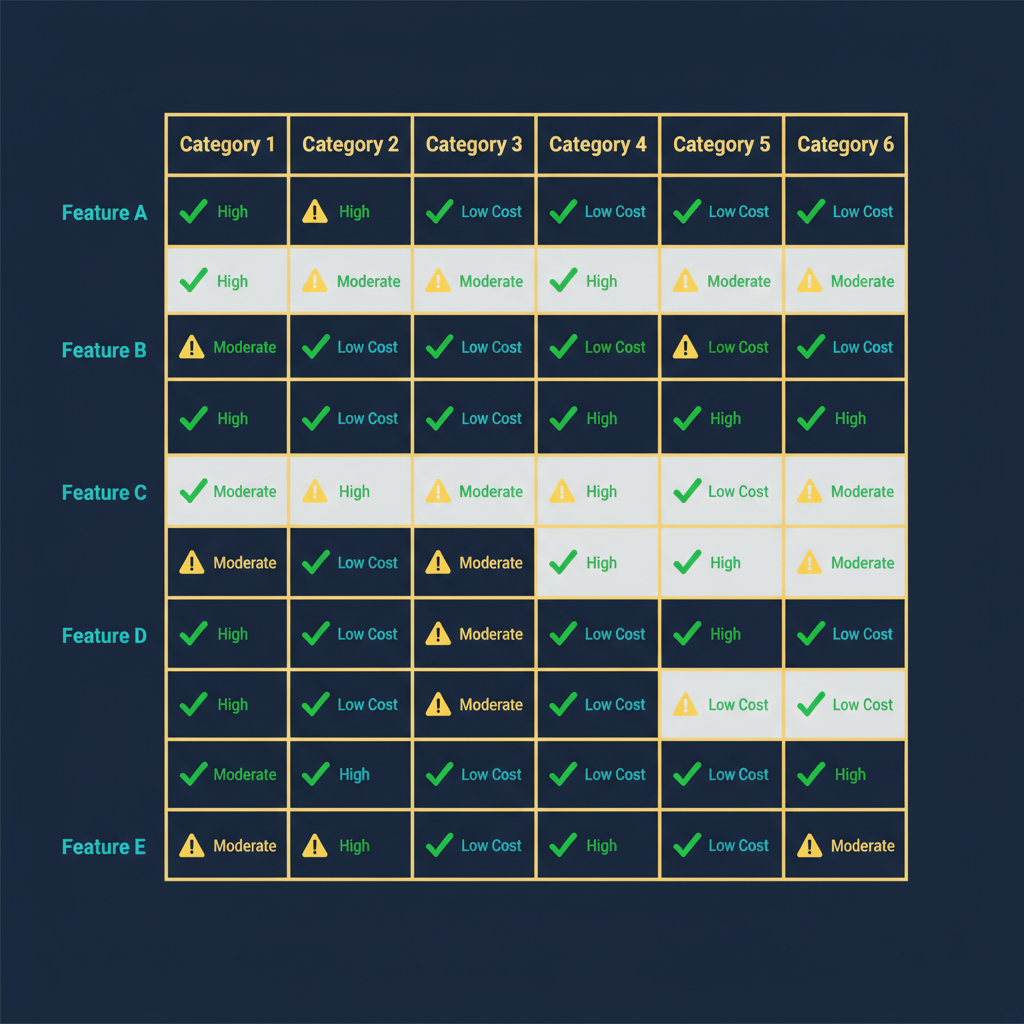
Image produced by Gemini-2.5-Flash
| Pattern | Audit Trail | Human Oversight | Determinism | Cost | Best For |
|---|---|---|---|---|---|
| Human-in-the-Loop | Native | Built-in | High | Medium | High-risk decisions, approval workflows |
| Reflection + Audit | With logging | Add separately | Moderate | Low | Analysis, recommendations, clinical support |
| Tool Use + Schema | Via schema logs | Add separately | High | Low | Data retrieval, calculations, integrations |
| Plan-and-Execute | Per-step logging | At checkpoints | Moderate | Medium | Complex workflows, multi-step processes |
| Single + Guardrails | Bounded scope | Add separately | High | Low | 70% of use cases, customer-facing |
The Composition Principle
These five patterns are not mutually exclusive. Production systems routinely compose two or three together.
Single Agent + Tool Use + Human-in-the-Loop covers the majority of regulated use cases with minimal complexity. A focused agent that invokes validated tools and escalates high-risk decisions.
Plan-and-Execute + Reflection + Human-in-the-Loop handles complex workflows requiring multi-step reasoning. The plan provides structure, reflection provides quality, human oversight provides compliance.
The principle: start with the simplest pattern that meets your requirements, then layer additional patterns only when the use case demands it. Every additional pattern increases your compliance surface area.
The Timeline Is Now
The EU AI Act's high-risk requirements take effect August 2, 2026. The US Treasury's Financial Services AI Risk Management Framework, with its 230 control objectives, was published February 2026. NIST launched its AI Agent Standards Initiative the same month.
Firms building with compliant patterns now have a structural advantage. Their AI systems pass regulatory examinations. Their engineering teams are not scrambling to retrofit governance. Their customers trust AI-driven services because the firms can demonstrate exactly how decisions are made.
Firms still experimenting with unconstrained multi-agent swarms, self-modifying agents, and autonomous goal pursuit are building technical debt that will become regulatory exposure.
Five patterns. Choose wisely.
Sources
- EU AI Act — Shaping Europe's Digital Future
- Agentic AI Governance Challenges Under the EU AI Act in 2026
- NIST AI Risk Management Framework
- NIST AI RMF: Agentic Profile — CSA Labs
- NIST Launches AI Agent Standards Initiative
- Decoding the US Treasury's AI Risk Management Framework — TCS
- Modernizing Regulated Industries with Cloud and Agentic AI — Microsoft
- 5 Production Scaling Challenges for Agentic AI in 2026
- The Multi-Agent Pattern That Actually Works in Production — Chanl
- Agentic AI Strategy — Deloitte Insights
- Agentic AI in Financial Services: A Research Roundup — Neurons Lab
- Human-in-the-Loop AI: Complete Implementation Guide — Synvestable
- How to Design AI Testing Systems for BFSI Compliance — TestGrid
Author's Bio
Terry Yodaiken advises investment and wealth managers on AI adoption, hybrid data architectures, and explainable decision systems. POVIEW.AI helps institutions build governed, production-grade AI that delivers measurable commercial outcomes.