Transparency Note: This article was written and edited by me — a real human being — with light assistance from AI-based editorial tools for grammar and structural clarity. All examples, data, and contextual insights were authored and verified by me. AI tools were not used to generate financial, technical, or compliance assertions. This disclosure is included for compliance with Medium transparency standards.
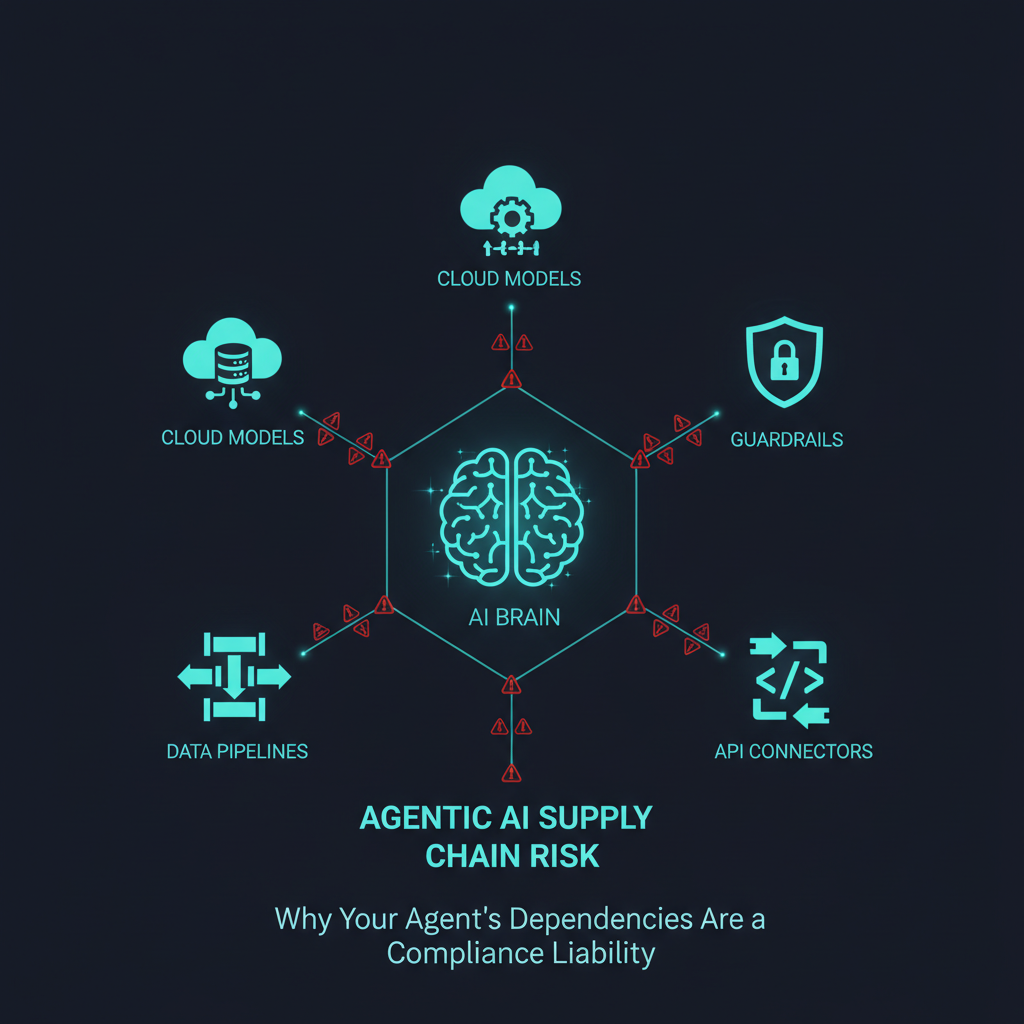
Your AI agent doesn't work alone. It calls models hosted by one provider, retrieves data through APIs maintained by another, executes tools built by a third, and runs on infrastructure operated by a fourth. Every one of those dependencies is a compliance liability you probably aren't tracking.
The supply chain problem financial services is ignoring
While the industry spent the past year debating prompt engineering and model selection, the real risk accumulated silently in the dependency graph — the web of third-party models, plugins, tool chains, and infrastructure that modern AI agents need to function.
The numbers are uncomfortable. Between January and March 2026, security researchers filed over 30 CVEs targeting MCP servers, clients, and infrastructure. Not trivial ones — ranging from path traversals to a CVSS 9.6 remote code execution flaw. The MCPTox benchmark found that leading LLM agents have a 72.8% attack success rate when exposed to tool poisoning attacks across 45 real-world MCP servers. And only 19% of organisations have full visibility into where and how AI is used across their development pipelines.
Nineteen per cent. Four out of five firms cannot see their own AI dependency graph.
In financial services — where DORA mandates tested exit strategies for critical ICT providers and the EU AI Act requires documented supply chain obligations for high-risk AI systems — this blind spot isn't technical debt. It's regulatory exposure waiting to be examined.
What makes an AI supply chain different
Traditional software supply chains are well understood. Libraries, packages, dependencies, registries. You have SBOMs, vulnerability scanners, and decades of tooling.
AI agent supply chains are fundamentally harder to govern.
A production AI agent in financial services typically depends on:
- Foundation models — hosted by OpenAI, Anthropic, Google, or self-hosted open-weight alternatives, each with their own update cadences and deprecation timelines
- Retrieval infrastructure — vector databases, embedding models, knowledge bases, and the data pipelines feeding them
- Tool integrations — MCP servers, API connectors, browser automation, database access, custom functions the agent calls at runtime
- Orchestration frameworks — LangChain, CrewAI, AutoGen, or custom agent loops coordinating multi-step workflows
- Prompt libraries — system prompts, few-shot examples, retrieval templates shaping agent behaviour
- Guardrail services — content filters, output validators, compliance checkers — often themselves third-party dependencies
Each layer has its own risk surface. A model provider pushes an update that changes output formatting. An MCP server maintainer introduces a vulnerability. An embedding model is deprecated, silently degrading retrieval quality. A prompt template is modified upstream, altering the agent's decision patterns.
Here's the critical difference from traditional software: when a library changes its API, you get a compile error or a test failure. When an AI dependency changes, you get a subtle behavioural shift — harder to detect, harder to attribute, and much harder to explain to a regulator.
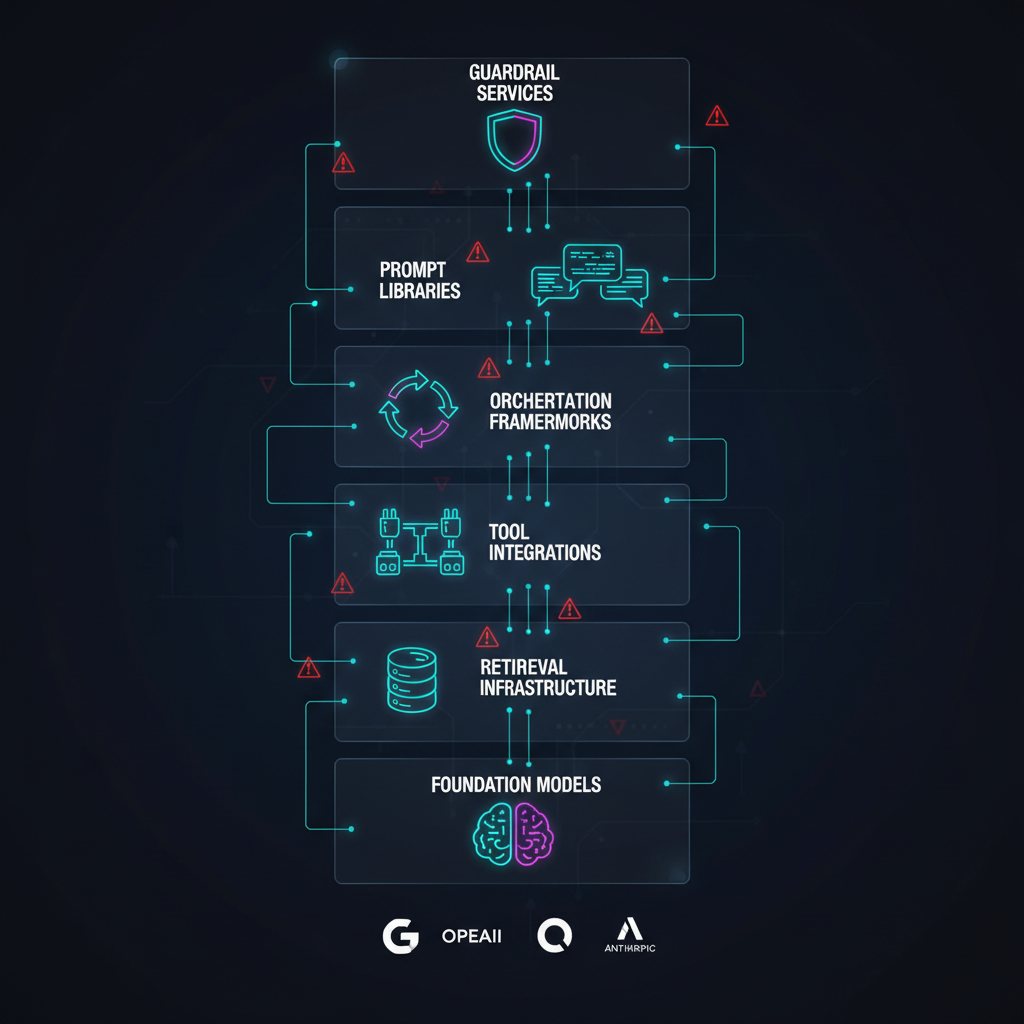
Image produced by Gemini-2.5-Flash
Five threats that need addressing now
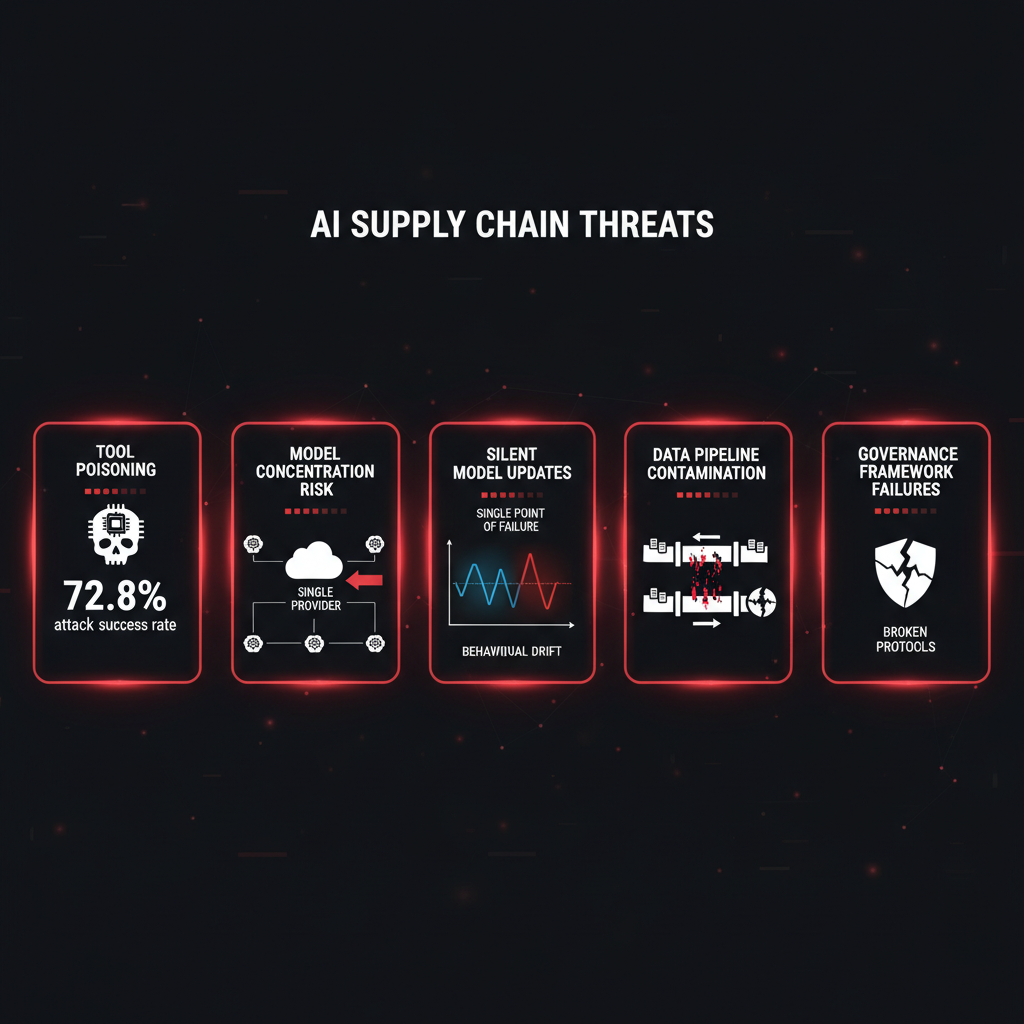
Image produced by Gemini-2.5-Flash
1. Tool poisoning and MCP compromise
OWASP classified Agentic Supply Chain Vulnerabilities as ASI04 in their 2026 Top 10 for Agentic Applications. The reason: agentic systems create an entirely new attack surface because they discover and integrate components during execution, not at build time.
An agent loading an MCP server at runtime trusts that server's tool definitions, schemas, and responses. That trust can be exploited.
Tool poisoning works by embedding hidden instructions in tool definitions — the metadata telling AI agents what each tool does. A malicious MCP server can steer agents into prolonged tool-calling chains, silently inflating per-query costs by up to 658x while evading standard defences with less than a 3% detection rate.
Real attack patterns documented in 2026:
- A compromised MCP server impersonating a trusted provider, harvesting credentials from enterprise deployments
- Malicious plugins injecting hidden prompts into runtime operations
- Rogue registries distributing tampered agent cards that redirect data to attackers
For financial services, where agents may access customer data, execute transactions, or make credit decisions, a compromised tool in the chain isn't theoretical. It's a potential data breach, a regulatory violation, and a customer harm event — all at once.
What to do: Sign and attest all tool descriptors and manifests. Maintain inventories of every MCP server and tool integration. Pin dependencies. Block untrusted sources. Run agents in sandboxed, network-restricted environments.
2. Model dependency and concentration risk
How many of your AI agents depend on a single model provider? If that provider has an outage, a policy change, or a pricing restructure, what happens to your operations?
Regulators are pressing hard on this. Microsoft's framework for financial institutions explicitly addresses concentration risk and exit planning — acknowledging that heavy reliance on a handful of AI infrastructure providers creates systemic vulnerability.
The concern isn't hypothetical. When a single provider handles your LLM inference, your embedding generation, and your guardrail filtering, you've created a single point of failure with regulatory implications.
DORA requires financial entities to maintain tested transition plans for critical ICT third-party providers. The UK PRA requires documented and tested exit strategies for material outsourcing arrangements. These aren't suggestions. They're enforceable requirements with examination consequences.
What to do: Map all AI model and infrastructure dependencies. Identify concentration points. Develop and test provider exit strategies. Maintain model-agnostic agent architectures that can switch providers without rebuilding.
3. Silent model updates and behavioural drift
Foundation model providers update their models regularly — sometimes with advance notice, sometimes without. Each update can change output formatting, reasoning patterns, safety filtering, and performance characteristics.
For a customer service chatbot, this might mean slightly different phrasing. For a credit decisioning agent in a regulated environment, a model update that shifts risk-scoring behaviour is a material change requiring validation, documentation, and potentially regulatory notification under SR 11-7 model risk management requirements.
The detection challenge is real. Traditional model monitoring assumes you control the model. When your model is hosted by a third party and updated on their schedule, you need observability infrastructure that can detect behavioural drift without access to model internals.
This extends beyond the primary model. Embedding models in RAG pipelines, classification models in routing, evaluation models in guardrails — all subject to upstream changes that cascade through your agent system.
What to do: Implement continuous behavioural monitoring with drift detection baselines. Contractually require advance notice of model updates from providers. Maintain validation test suites that run automatically when upstream changes are detected.
4. Data pipeline contamination
Your agent's knowledge base is only as trustworthy as the pipeline feeding it. In financial services, that typically means regulatory documents, market data feeds, internal policies, customer records, and compliance guidance — all flowing through extraction, transformation, and indexing stages with their own dependency chains.
Each stage carries risk:
- The PDF extraction library that misparses a regulatory update
- The web scraping service that introduces stale or incorrect data
- The embedding model that changes its dimensional output after an update, silently corrupting your vector index
- The data provider that alters their API response format without notification
OWASP's cascading failures classification (ASI08) is directly relevant: contaminated data entering the pipeline at one point propagates through the entire system. Each downstream component adds a layer of plausible reasoning that obscures the original error.
What to do: Validate data freshness and integrity at every pipeline stage. Version-control all data transformations. Implement ground-truth verification for high-stakes data sources. Monitor embedding quality metrics for drift.
5. Governance framework dependencies
Here's the irony most firms miss: the tools you deploy to govern your AI agents are themselves third-party dependencies with their own supply chain risks.
Your content filter? A third-party API. Your compliance checker? An LLM-based system with its own model dependency. Your audit logging service? A SaaS platform with its own uptime guarantees and data residency policies.
When your governance infrastructure fails — or silently degrades — you lose the ability to detect problems in the systems you're monitoring. 95% of organisations have experienced at least one AI incident. Governance framework failures are among the hardest to detect because the monitoring itself is compromised.
What to do: Treat governance infrastructure as critical dependencies requiring their own resilience planning. Build redundancy for compliance-critical monitoring. Ensure governance tools have independent failure modes — they should not share infrastructure with the systems they monitor.
Four pillars for AI supply chain governance
Pillar 1: AI Bill of Materials (AIBOM)
An AI Bill of Materials is a continuously updated, machine-readable inventory listing every dataset, model, software component, tool integration, and prompt template used to build and operate an AI system. It extends the SBOM concept to cover what traditional SBOMs cannot: non-deterministic models, evolving algorithms, and data dependencies.
For financial services, an AIBOM must include:
- Model inventory — every foundation model, fine-tuned variant, embedding model, and evaluation model, with version numbers and provider details
- Tool registry — every MCP server, API integration, and external tool the agent can access, with attestation status
- Data lineage — provenance chains for every data source feeding the agent's knowledge base
- Prompt inventory — versioned system prompts, templates, and few-shot examples
- Dependency graph — the full chain of how components interact, including transitive dependencies
The OWASP AIBOM project is building standardised approaches. Frameworks like SPDX and CycloneDX are extending to support AI-specific metadata. Whether the EU AI Act audit deadline falls in August 2026 or is extended, the documentation must be ready.
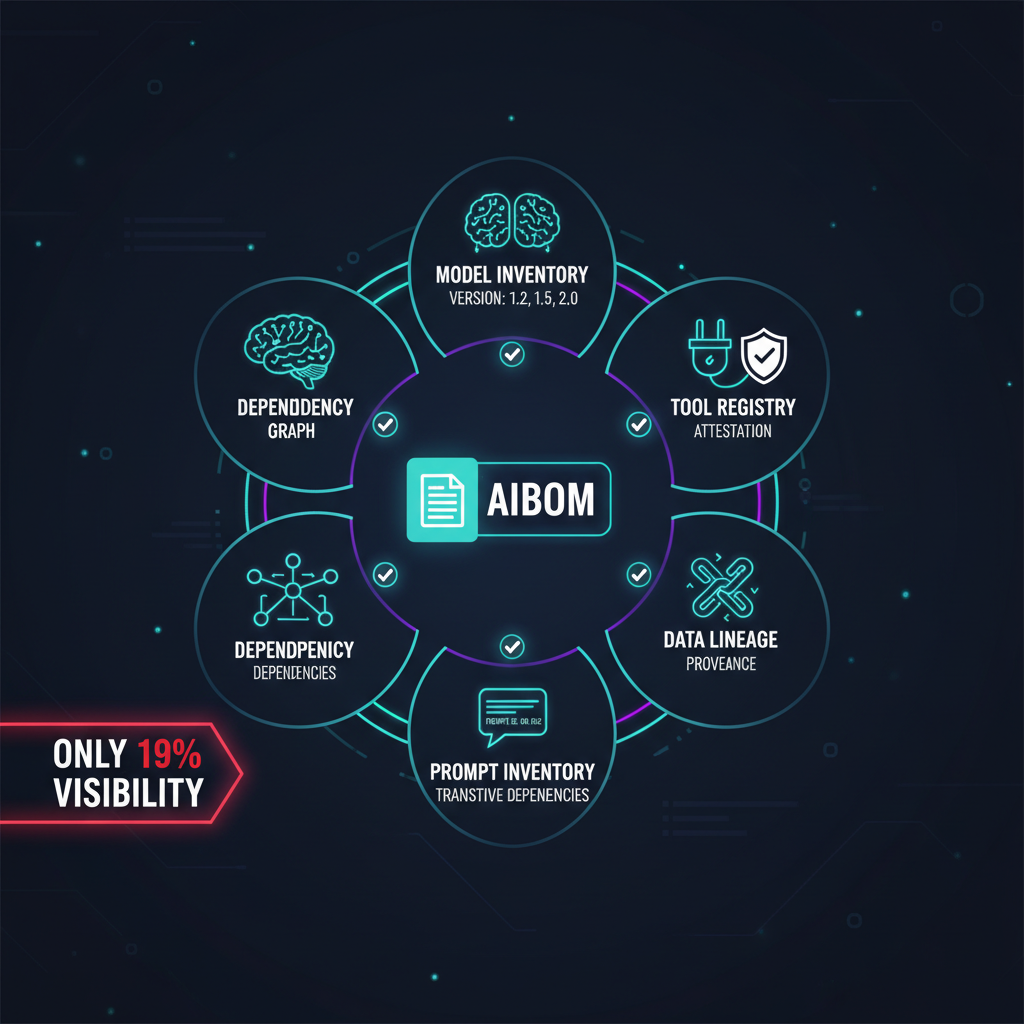
Image produced by Gemini-2.5-Flash
Pillar 2: Continuous dependency monitoring
Static point-in-time audits are not enough for AI supply chains that change dynamically. Production governance requires:
- Runtime dependency tracking — which MCP servers, models, and tools did each agent invocation actually use?
- Behavioural drift detection — has any component's output changed meaningfully since the last baseline?
- Vulnerability scanning — are any dependencies affected by known CVEs or security advisories?
- Cost anomaly detection — has any tool or model integration started consuming resources outside expected parameters? Tool poisoning can inflate costs by up to 658x.
- Compliance status tracking — are all dependencies still within their attested scope?
Pillar 3: Provider risk management
Financial services regulators already require third-party risk management for traditional technology providers. AI providers require the same discipline — plus additional considerations:
- Contractual protections — advance notice of model updates, data handling guarantees, incident notification requirements, audit rights
- Exit planning — tested migration paths for every critical AI dependency, as DORA requires for all critical ICT providers
- Concentration mapping — identifying where multiple agent systems depend on the same provider, creating systemic exposure
- Subcontractor visibility — understanding your providers' own dependencies. Your model host's infrastructure provider. Your tool vendor's data sources.
Pillar 4: Runtime sandboxing and isolation
Agents that discover and integrate components at runtime need infrastructure-level controls that limit blast radius:
- Network isolation — agents can only reach pre-approved endpoints
- Tool allowlisting — only attested, inventoried tools can be invoked
- Resource budgets — per-invocation limits on API calls, tokens, and compute
- Data classification enforcement — agents handling regulated data cannot pass it to unclassified tools
- Immutable audit trails — every tool call, model invocation, and data access is logged with full provenance
Three regulatory frameworks converging
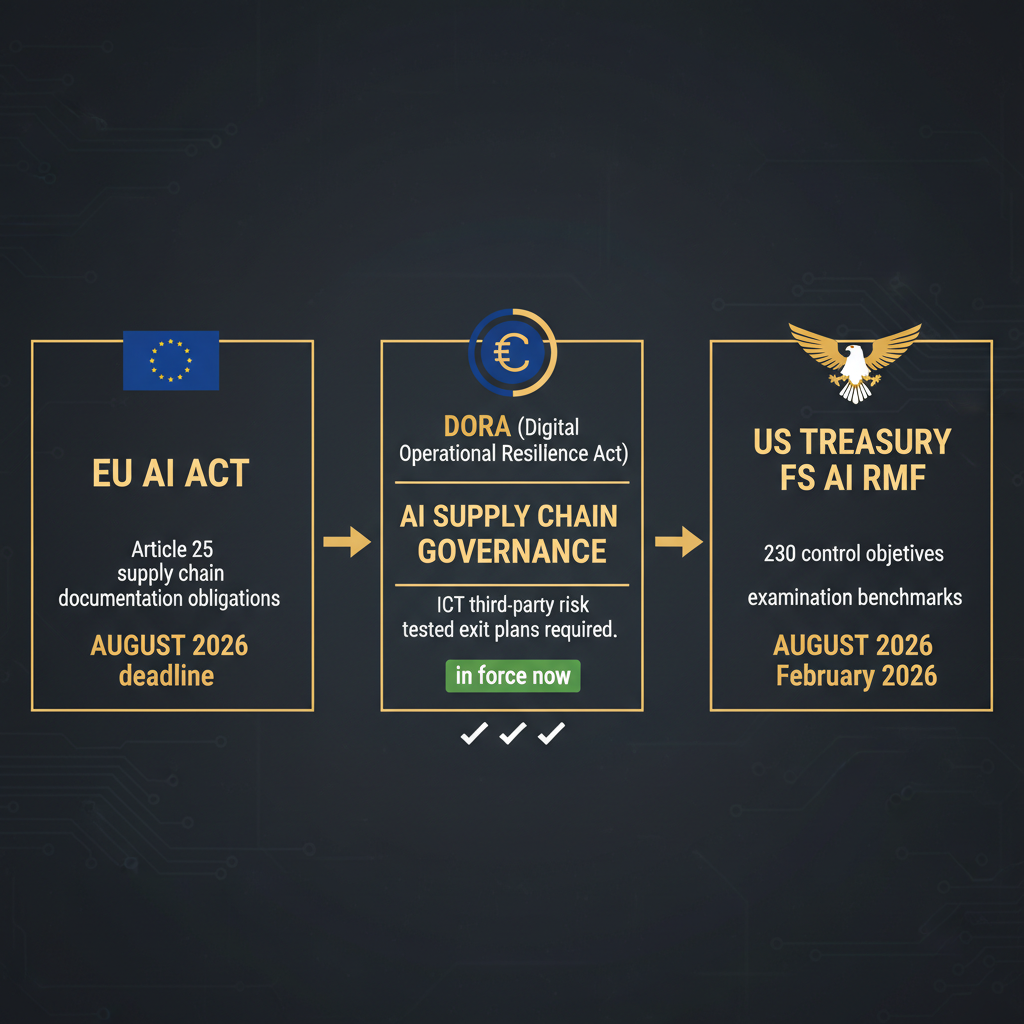
Image produced by Gemini-2.5-Flash
EU AI Act — Supply chain obligations (August 2, 2026)
Article 25 establishes explicit responsibilities along the AI value chain. Providers of high-risk AI systems and third parties supplying components must agree in writing on necessary information, capabilities, and technical access. Importers and distributors have verification obligations. Post-market surveillance requires ongoing monitoring of the entire supply chain.
DORA — ICT third-party risk (in force)
The Digital Operational Resilience Act requires financial entities to adopt strategies for ICT third-party risk, maintain tested exit plans, and submit Registers of Information documenting all ICT third-party arrangements — including subcontractors. AI model providers and tool vendors fall squarely within scope.
US Treasury FS AI RMF — 230 control objectives (February 2026)
The Financial Services AI Risk Management Framework includes specific control objectives around third-party AI governance, model inventory management, and supply chain resilience. US financial regulators are already using these as examination benchmarks.
FINRA's 2026 Regulatory Oversight Report identifies AI governance as a priority examination area, with third-party AI dependencies flagged as a specific concern.
This is already happening
Supply chain-related breaches increased by nearly 40% since 2023. AI-specific incidents are accelerating.
OpenAI Plugin Ecosystem (2026): A supply chain attack on the plugin ecosystem resulted in compromised agent credentials harvested from 47 enterprise deployments. Attackers accessed customer data, financial records, and proprietary code for six months before discovery.
MCP Server Vulnerabilities (Jan–Mar 2026): Over 30 CVEs filed in 60 days, including a CVSS 9.6 remote code execution flaw. Root causes: missing input validation, absent authentication, blind trust in tool descriptions.
8,000+ Exposed MCP Servers (2026): Research identified thousands of MCP servers exposed to the public internet without adequate authentication or access controls.
Code Registry Compromise (2025): The 'Shai-Hulud' attack compromised a public package registry, distributing malicious code through routine updates to an estimated 25,000 downstream projects.
For financial services firms deploying agentic AI, each of these is a scenario that could trigger regulatory reporting obligations, customer notification requirements, and supervisory scrutiny.
From blind spot to governed dependency
The AI supply chain problem isn't going away. It's getting more complex as agentic systems become more capable and more deeply integrated into financial operations. Every new tool, model, and data source your agent touches extends your compliance surface.
The firms that will get this right are the ones that:
- Treat AI dependencies like financial counterparties — with due diligence, monitoring, and exit planning
- Build AIBOMs now — before auditors ask for them
- Monitor continuously — not quarterly
- Sandbox aggressively — assume any dependency could be compromised
- Own the supply chain organisationally — designate accountability for the full dependency graph, not just the agent logic
The 19% visibility figure isn't a security statistic. It's a governance gap that regulators are about to start examining. The question isn't whether your AI agent's supply chain will be scrutinised. It's whether you'll be ready when it is.
Map the chain. Govern the dependencies. Build the AIBOM.
Sources
- OWASP Top 10 for Agentic Applications 2026 — OWASP
- MCP Security 2026: 30 CVEs in 60 Days — HeyuanIO
- MCP Security Vulnerabilities: Prompt Injection and Tool Poisoning — Practical DevSecOps
- 8,000+ MCP Servers Exposed — Nyami / Medium
- AI-BOMs: A Practical Guide — Wiz
- AIBOM: The Complete Guide — Cycode
- Article 25: EU AI Act Supply Chain Obligations
- EU AI Act Timeline — DataGuard
- DORA Article 28: ICT Third-Party Risk
- ICT Exit Strategies for DORA — Panorays
- Managing Concentration Risk: Framework for Financial Institutions — Microsoft
- US Treasury FS AI Risk Management Framework — TCS
- FINRA 2026 Regulatory Oversight Report — Sidley Austin
- AI-Driven Supply Chain Attacks — NeuralTrust
- State of AI Trust 2026 — McKinsey
- Key Trends From RSAC: Agentic AI, MCP, and Supply Chain Risks — Futuriom
- Agentic AI Sprawl: The New Risk CFOs Didn't See Coming — ChatFin
- 2025 Supply Chain Threat Landscape — SecureWorld
- Cascading Failures in Agentic AI — Adversa AI / OWASP ASI08
Author's Bio
Terry Yodaiken advises investment and wealth managers on AI adoption, hybrid data architectures, and explainable decision systems. POVIEW.AI helps institutions build governed, production-grade AI that delivers measurable commercial outcomes.